|
Editorial by Russell Bowen
|
|
Andy Rooney, from the TV show of
60 Minutes, isn’t the only one with an opinion. Everyone has an opinion on
something. Here are some opinions that I have concerning the life
endangering topic of hazardous materials or dangerous goods information during a transportation
incident or accident. Unless the entire emergency response community demands
and receives the best that industry currently can provide, who wins?
For all first responders to a
transportation emergency scene involving an aircraft or a surface vehicle, one
of the first considerations, in my opinion, should be:
"Are there any hazardous
materials on board and if so, where and how much?"
While one of the primary objectives
for first responders is to neutralize and contain a hazardous materials spill
or incident, the safety and well-being of the responders and others involved
in the incident must also be a priority.
A way of notifying any emergency
responder of critical hazmat information should be available immediately upon
demand and automated. An automated Notification to the Pilot in Command
(NOTOC) or “NOPIC or Pilot Notification Form (PNF)” or Truck Manifest that
has emergency response information from two sources contained on it would
certainly fill the bill here. Although there has been much talk and meetings
on the subject, including a meeting in Washington D.C., by interested
parties, little has been done to resolve the lack of timely, accurate and
automated hazmat information to all emergency responders.
The first source of information should
be from the Emergency Response Guidebook (ERG) that was developed jointly by
the US Department of Transportation, Transport Canada, and the Secretariat of
Communications and Transportation of Mexico (SCT). The second source is the
International Civil Aviation Organization (ICAO) Emergency Response Guidance
for Aircraft Incidents involving dangerous goods (known as the ICAO Red
Book). For the first responder, these sources of information are essential
for not only addressing the incident but also conveying information about
protective clothing, evacuation and first aid.
Onboard the aircraft, the pilot and crew could be considered the first line of defense involving any type of emergency, including a hazardous material spill or incident, and they are in essence the first responders while the aircraft is in the air. Emergency procedures will differ onboard an aircraft in flight vs. procedures to follow while the aircraft is on the ground. Under the guidance of the International Civil Aviation Organization, the ICAO Red Book has been developed with the assistance of the Dangerous Goods Panel to provide guidance to countries and airlines for dealing with dangerous goods emergencies while the aircraft is in the air.
The crew is supplied information
related to the inherent risk, risk to aircraft, risk to occupants, spill or
leak procedures, firefighting procedures and additional considerations. On
board a truck, the procedures for addressing emergency response are outlined
on a Truck Manifest using the Emergency Response Guidebook (ERG), including
inhalation hazards procedures and ERIP Name or Contract number if provided.
The information made available to
all should also include the name of the chemical, the UN identification number,
class hazard, the degree of danger known as the UN Packing Group Number,
quantity per package and a description of the package and where on the
aircraft or truck the package is located.
This information should be
immediately available from the airline involved to a first responders, free
of charge, by using the world wide web. The entire NOTOC or Truck Manifest form
should be made available to be immediately e-mailed to any MAPI-compliant e-mail
address anywhere in the world within seconds (terminals, smart phones,
airport towers, response vehicles, etc.).
While en-route to the scene
of a hazmat incident, a first responder that has a smartphone should receive
not only the NOTOC or Truck Manifest via e-mail , but also receive a summary
in the front end of that e-mail of all of the dangerous goods onboard the
aircraft or truck by position number, reflecting total quantity by class
hazard, ERG Guide Numbers as well as emergency response telephone numbers of
the emergency response information provider.
These opinions are that of just
one person. Should there be more consideration given to the topic? Unless the
entire emergency response community demands and receives the best that
industry can currently provide, who wins?
|
Showing posts with label ICAO. Show all posts
Showing posts with label ICAO. Show all posts
Tuesday, December 6, 2011
The Need for Standardizing the Distribution of Emergency Response Information

Wednesday, September 7, 2011
What is a Q-value? For dangerous goods air transport?
Introduction and Background
When a shipper packs two or more dangerous goods (or hazardous materials, hazmat) into one combination package for air transport, there are additional requirements over and above the general packing requirements and compatibility compliance within the ICAO/IATA regulations.
Shippers must also be aware of possible:
This becomes difficult when your package contains dangerous goods of different physical states.
To address this issue, the ICAO Technical Instructions (TI) published a new requirement in 1985 for calculating the maximum quantity allowed for multiple dangerous goods contained in one outer packaging, regardless of the physical state. The IATA Dangerous Goods Regulations (DGR) quickly followed suit.
This new requirement was called the "Q-value". As outlined in IATA DGR 5.0.2.11(g), the Q-value is applied to packing such that, "the quantities of different dangerous goods contained in one outer packaging must be such that "Q" does not exceed the value of 1.0."
Applicability
The Q-value is calculated by using the formula of:

Where n1, n2, etc. are the net quantities per package of the different dangerous goods, and M1, M2, etc. are the maximum net quantities allowed per package for these different dangerous goods according to the List of Dangerous Goods in Section 4 of the IATA DGR.
The sum, Q, must be equal to or less than 1. The sum must be rounded up to the nearest tenth (or first decimal place). This formula is applicable whenever more than one dangerous goods is packed or contained within a combination package intended for air transport.
Example
A shipper is shipping the following dangerous goods contained in the same outer fiberboard box:

This gives a Q-value of 0.3. Since the Q-value is equal to or less than 1, these dangerous goods quantities may be all packed into one 4G fiberboard box. If the Q-value exceeded 1, the quantities of dangerous goods would have to be reduced until the Q-value of 1 or lower is achieved.
Exclusions
The following dangerous goods are not considered in the calculation of the Q-value:
There are additional considerations to take into account when dealing with multiple dangerous goods being packed into one outer package.
These can include (but are not limited to):
Regulatory Staff
Bureau of Dangerous Goods, Ltd.
When a shipper packs two or more dangerous goods (or hazardous materials, hazmat) into one combination package for air transport, there are additional requirements over and above the general packing requirements and compatibility compliance within the ICAO/IATA regulations.
Shippers must also be aware of possible:
- Combustion and/or evolution of considerable heat,
- Evolution of flammable gases that asphyxiate or are toxic,
- Formation of corrosive substances, or
- Formation of unstable substances if the materials mix.
This becomes difficult when your package contains dangerous goods of different physical states.
To address this issue, the ICAO Technical Instructions (TI) published a new requirement in 1985 for calculating the maximum quantity allowed for multiple dangerous goods contained in one outer packaging, regardless of the physical state. The IATA Dangerous Goods Regulations (DGR) quickly followed suit.
This new requirement was called the "Q-value". As outlined in IATA DGR 5.0.2.11(g), the Q-value is applied to packing such that, "the quantities of different dangerous goods contained in one outer packaging must be such that "Q" does not exceed the value of 1.0."
Applicability
The Q-value is calculated by using the formula of:
Where n1, n2, etc. are the net quantities per package of the different dangerous goods, and M1, M2, etc. are the maximum net quantities allowed per package for these different dangerous goods according to the List of Dangerous Goods in Section 4 of the IATA DGR.
The sum, Q, must be equal to or less than 1. The sum must be rounded up to the nearest tenth (or first decimal place). This formula is applicable whenever more than one dangerous goods is packed or contained within a combination package intended for air transport.
Example
A shipper is shipping the following dangerous goods contained in the same outer fiberboard box:
- 1.0 Liter of UN1114, Benzene, Class 3, PG II, using packing instruction 353
(max. net quantity per package for 353 is 5 Liters) - 2.0 kilograms of UN2803, Gallium, Class 8, PG III, using packing instruction 867
(max. net quantity per package for 867 is 20 kilograms)
This gives a Q-value of 0.3. Since the Q-value is equal to or less than 1, these dangerous goods quantities may be all packed into one 4G fiberboard box. If the Q-value exceeded 1, the quantities of dangerous goods would have to be reduced until the Q-value of 1 or lower is achieved.
Exclusions
The following dangerous goods are not considered in the calculation of the Q-value:
- UN1845, Dry ice,
- Those where Columns J or L in the IATA List of Dangerous Goods indicate "No Limit",
- Those with the same UN number, packing group and physical state (e.g. solid or liquid), provided they are the only dangerous goods in the package and the total net quantity does not exceed the maximum net quantity shown in the List of Dangerous Goods, or
- Those where Columns J or L in the IATA List of Dangerous Goods indicate a gross weight per package.
There are additional considerations to take into account when dealing with multiple dangerous goods being packed into one outer package.
These can include (but are not limited to):
- IATA DGR 8.1.6.9.2(f) for describing how these packages are declared on the shipper's declaration for dangerous goods:
- For one package, the phrase "All Packed in One (description of package type)" must immediately follow the relevent entries (e.g. "All Packed in One Fiberboard Box"), and
- For multiple packages, the phrase "All Packed in One (description of package type) x (number of packages)" must immediately follow the relevant entries (e.g. "All Packed in One Fiberboard Box x 3").
- The outer package must be allowed for all dangerous goods contained within it,
- The outer package must meet the specification performance tests for the most restrictive packing group of the a substance or article within the package,
- Must comply with inner packaging requirements, and
- When a package contains a dangerous goods with the letter "G" following the quantity shown in Columns J or L in the IATA List of Dangerous Goods, the gross weight of the completed package does not exceed the lowest applicable gross weight.
Regulatory Staff
Bureau of Dangerous Goods, Ltd.
Thursday, July 28, 2011
Common misapplication of the UN packing group number for IATA/ICAO dangerous goods shipments
As most of us have been taught by our dangerous goods instructor, the UN Packing Group Number (I, II or III) denotes the degree of danger for a particular dangerous goods. UN Packing Group I, II or III means respectively, high, medium or low danger.
Criteria for these groups have been developed for dangerous goods in Class 3, Class 4, Division 5.1, Division 6.1 and Class 8. Whenever a UN Packing Group Number is reflected in Column F of the Alphabetical List in the IATA Dangerous Goods Regulations (and Column 8 of the ICAO Technical Instructions), with a few exceptions, this number must then be reflected on the shipping document.
A frequent misapplication of this requirement happens when a shipper will notice a UN Packing Group Number reflected in the text of a Packing Instruction Number (PIN) that is not reflected in either Column F or Column 8.
For example, a Class 1 material, UN0456, Detonators, electric, is referenced to PIN 131 for either Passenger or Cargo Aircraft Only preparation in the Alphabetical List of Dangerous Goods and Column F is blank for the Packing Group (Column 8 in ICAO for the same Class 1 material is also blank). The reasoning for the blank packing group column is that Class 1 dangerous goods have not had packing group criteria developed yet by IATA and ICAO.
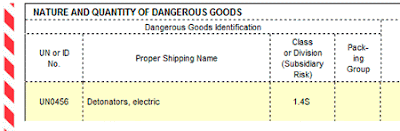
In the text of PIN 131, it states, "Unless otherwise provided for in these Regulations, packagings must meet Packing Group II requirements". In general, this statement refers to the degree of integrity that the packaging must have, not the degree of danger of the dangerous goods.
The UN Committee of Experts uses the letter of X, Y or Z to denote what UN Packing Group Numbers are authorized in a UN package.
Unfortunately, this misapplication isn't normally caught until after the shipment has been delivered to the airline, and has been inspected by the airline's dangerous goods specialist or technician utilizing a checklist. Upon detection of the error, the shipment has now automatically incurred a delay until corrected by the shipper. Upon inspection of the airline's dangerous goods file (kept by the airline for a period of 1-2 years depending on the country concerned) of dangerous goods shipments by a regulatory officer, the shipper may be asked additional questions regarding the shipment.
Criteria for these groups have been developed for dangerous goods in Class 3, Class 4, Division 5.1, Division 6.1 and Class 8. Whenever a UN Packing Group Number is reflected in Column F of the Alphabetical List in the IATA Dangerous Goods Regulations (and Column 8 of the ICAO Technical Instructions), with a few exceptions, this number must then be reflected on the shipping document.
A frequent misapplication of this requirement happens when a shipper will notice a UN Packing Group Number reflected in the text of a Packing Instruction Number (PIN) that is not reflected in either Column F or Column 8.
For example, a Class 1 material, UN0456, Detonators, electric, is referenced to PIN 131 for either Passenger or Cargo Aircraft Only preparation in the Alphabetical List of Dangerous Goods and Column F is blank for the Packing Group (Column 8 in ICAO for the same Class 1 material is also blank). The reasoning for the blank packing group column is that Class 1 dangerous goods have not had packing group criteria developed yet by IATA and ICAO.

In the text of PIN 131, it states, "Unless otherwise provided for in these Regulations, packagings must meet Packing Group II requirements". In general, this statement refers to the degree of integrity that the packaging must have, not the degree of danger of the dangerous goods.
The UN Committee of Experts uses the letter of X, Y or Z to denote what UN Packing Group Numbers are authorized in a UN package.
- Using the letter X, means that the package is authorized to contain a Packing Group I, II or III material.
- Using the letter Y, means that the package is authorized to contain a Packing Group II or III material.
- Using the letter Z, means that the package is authorized to contain a Packing Group III material only.
Unfortunately, this misapplication isn't normally caught until after the shipment has been delivered to the airline, and has been inspected by the airline's dangerous goods specialist or technician utilizing a checklist. Upon detection of the error, the shipment has now automatically incurred a delay until corrected by the shipper. Upon inspection of the airline's dangerous goods file (kept by the airline for a period of 1-2 years depending on the country concerned) of dangerous goods shipments by a regulatory officer, the shipper may be asked additional questions regarding the shipment.
Monday, April 11, 2011
HR 658 Transporting Lithium Batteries in the United States

Lithium Batteries
Ever since January 11, 2010, when Hazardous Materials docket HM-224F was published concerning Lithium batteries, the entire global shipping and transportation industry was very concerned that the ability to send lithium batteries via air transport was going to be severely restricted in the United States.
In January 2010, the DOT proposed to remove exceptions for small lithium batteries (Section II of the Lithium Battery packing instruction numbers of the IATA/ICAO Regulations), effectively making them fully regulated Class 9 hazardous materials like their medium and large-sized counterparts.
Change of Direction
Approval today, April 5, 2011, by the U.S. House of Representatives of HR 658, the Federal Aviation Administration (FAA) Reauthorization and Reform Act, which includes a provision directing the U.S. Department of Transportation (DOT), to ensure that its regulations governing the air transport of lithium ion or lithium metal batteries and products that contain or are packed with these batteries are no more stringent than international requirements in place at any time. The one exception allowed is the continuance of the U.S. prohibition of air shipment of lithium metal cells and batteries on passenger aircraft.
The House approved HR 658 by a vote of 223-196 and will have to reconcile it with a Senate-passed bill that does not include any provisions pertaining to lithium batteries. The battery provision, offered by Transportation and Infrastructure Committee Chairman John Mica (R-FL), was approved by a bipartisan vote of 251-168.
Chairman Mica's harmonization amendment directs DOT to not issue or enforce any regulations regarding the air transportation of lithium metal cells or batteries, or lithium ion cells or batteries, or products that use them, that are more stringent than requirements pertaining to lithium batteries in the 2011-2012 Edition of the ICAO Technical Instructions for the Safe Transport of Dangerous Goods by Air or any future amendments to those instructions.
Although this Approval is not a Final Rule yet in the transportation regulations of the USA, it gives the transportation industry and shippers of Lithium Batteries the insight necessary for them to make business decisions on the future ability to transport lithium batteries by air in the United States.
Tuesday, January 18, 2011
HM-215K Harmonization of PHMSA Hazardous Materials Regulations with International Standards for Dangerous Goods
The Pipeline and Hazardous Materials Safety Administration (PHMSA) is scheduled to publish docket HM-215K tomorrow regarding the harmonization of U.S. Hazardous Materials Regulations with the United Nations Recommendations, IMDG Code and ICAO Technical Instructions for the Safe Transport of Dangerous Goods by Air.
International standards will be adopted by the Hazardous Materials Regulations that include changes to proper shipping names, hazard classes, packing groups, special provisions, packaging authorizations, air transport limited quantities and vessel stowage requirements.
Voluntary compliance begins on January 1, 2011.
Mandatory compliance with the amendmends adopted in HM-215K begins on January 1, 2012.
To read the full docket HM-215K regarding harmonization, please click on the link below:
Harmonization docket HM-215K
International standards will be adopted by the Hazardous Materials Regulations that include changes to proper shipping names, hazard classes, packing groups, special provisions, packaging authorizations, air transport limited quantities and vessel stowage requirements.
Voluntary compliance begins on January 1, 2011.
Mandatory compliance with the amendmends adopted in HM-215K begins on January 1, 2012.
To read the full docket HM-215K regarding harmonization, please click on the link below:
Harmonization docket HM-215K
Thursday, June 18, 2009
Standardizing hazmat cargo information for first responders to arrive at an emergency scene involving an aircraft
For all first responders to arrive at an emergency scene involving an aircraft, one of the primary considerations is: Is there any hazmat (hazardous materials, dangerous goods) on board, and if so, where and how much?
The Bureau of Dangerous Goods, Ltd. has the answer. Airlines have begun using a commercially available software and Internet application known as HAZMAT®. Built into this software is a module called the NOTOC Navigator. This module is capable of generating automated, fully compliant NOTOC (Notification to the Pilot in Command) documentation containing all applicable emergency response information related to the cargo at the emergency scene. Emergency response information contained on the NOTOC is based on the North American Emergency Response Guidebook (ERG) and the United Nations International Civil Aviation Organization (ICAO) Emergency Response Guidance for Aircraft Incidents Involving Dangerous Goods (Red Book).
In addition, the name of the chemical, it's UN identification number, class hazard, the degree of danger (UN packing group number), quantity per package, a description of the package and where on board the aircraft the package is located are also provided on the NOTOC for each hazmat package.
Emergency response information from the NOTOC Navigator is available from the participating airline involved to any first responder via electronic transmission. Each NOTOC can be electronically mailed to any MAPI-compliant email address anywhere around the world within seconds.
The Bureau of Dangerous Goods, Ltd. is dedicated to promoting the idea of standardizing the information on NOTOCs. This process would help eliminate the potential for individual interpretation and give first responders immediate access to information pertaining to hazmat on board a downed aircraft, how to minimize and contain contamination, and improve safety protocol in handling hazmat at an emergency scene. The NOTOC Navigator accomplishes each of these tasks by producing a standardized document with the necessary information that first responders need to secure and contain an emergency scene involving an aircraft and hazmat.
For more informaton about the NOTOC Navigator, visit the Bureau of Dangerous Goods website and go to our software section.
The Bureau of Dangerous Goods, Ltd. has the answer. Airlines have begun using a commercially available software and Internet application known as HAZMAT®. Built into this software is a module called the NOTOC Navigator. This module is capable of generating automated, fully compliant NOTOC (Notification to the Pilot in Command) documentation containing all applicable emergency response information related to the cargo at the emergency scene. Emergency response information contained on the NOTOC is based on the North American Emergency Response Guidebook (ERG) and the United Nations International Civil Aviation Organization (ICAO) Emergency Response Guidance for Aircraft Incidents Involving Dangerous Goods (Red Book).
In addition, the name of the chemical, it's UN identification number, class hazard, the degree of danger (UN packing group number), quantity per package, a description of the package and where on board the aircraft the package is located are also provided on the NOTOC for each hazmat package.
Emergency response information from the NOTOC Navigator is available from the participating airline involved to any first responder via electronic transmission. Each NOTOC can be electronically mailed to any MAPI-compliant email address anywhere around the world within seconds.
The Bureau of Dangerous Goods, Ltd. is dedicated to promoting the idea of standardizing the information on NOTOCs. This process would help eliminate the potential for individual interpretation and give first responders immediate access to information pertaining to hazmat on board a downed aircraft, how to minimize and contain contamination, and improve safety protocol in handling hazmat at an emergency scene. The NOTOC Navigator accomplishes each of these tasks by producing a standardized document with the necessary information that first responders need to secure and contain an emergency scene involving an aircraft and hazmat.
For more informaton about the NOTOC Navigator, visit the Bureau of Dangerous Goods website and go to our software section.
Subscribe to:
Posts (Atom)